Chinese Dairy Market Looks Promising 1
The global dairy market is likely to “remain tight” in 2011, due to animprovement in demand but limited supply, according to Rabobank. Thebank said in its Global Dairy Outlook report last December that althoughconsumption rates are set to be strong in the new year, growth in someregions will be constrained by physical limitations of supply.
“Drought in Russia and floods in Pakistan will heavily impact local milkproduction in the first half of 2011”, said Rabobank.
While these conditions are likely to create increased demand for imports,the bank said that domestic consumption is likely to be restricted.Consumption is expected to be supported by improving labour markets inthe West, strong economic growth in import regions and strong buying inChina.
Factors effecting supply levels include higher feed costs, ongoingrequirements for farmers to reduce debt levels and the likelihood oflimited supply growth beyond New Zealand. An increase in grain pricescould also “dampen” milk production volumes and consequently lead to anincrease in dairy prices, said the bank.
Rabobank has also changed its view on the likely role of China and Indiain global dairy markets. The bank has abandoned the view that thecountries will reach self-sufficiency soon and now predicts that they willcall on the world market more frequently in the next three to four years.Rabobank said that China in particular has a structural deficit that will bedifficult to erode in coming years.
In 2010, China's milk and dairy industry mainly showed the followingcharacteristics and changes:
- There was a raw milk supply shortage in 2010, but dairy imports andproduction substantially increased. Liquid milk and solid dairyproduction and consumption continuously grew, the supply anddemand basically kept balance.
- Out of deficit, cattle farming went though narrow margin of profit ingeneral.
- China's dairy producing companies strengthened the construction ofmilk resource bases, especially large-scale enterprises. Theproportion of cow farms with more than 100 inventories accounts for28.48% of the national total.
- In 2010, the total 13,500 milk purchasing stations were all certified,which effectively protecting the milk quality.
- Dairy processing projects that were newly built and expandedincreased significantly. In addition, the implementation of new ruleson the access to dairy production promoted the centralized andscaled development of dairy industry.
- The market of infant/young children's milk powder in China was moreof a concern and domestic companies entered the top-end powdermarket though purchasing foreign raw milk bases, producing foreignagents, etc. However, imported milk powder makes up over 80% inthe top-end powder market in China.
This year, the main development trends of the milk and dairy market willbe expected as follows: the supply of domestic milk supply rallies; thetotal dairy imports continue to increase; the milk and dairy market are a balance between supply and demand; the dairy producing capacitycontinues to expand, with optimization of product structure.
The development I am watching is the Infant Formula Industry inChina.
China is the world’s most populous country and one of the fastestgrowing pediatric milk formula markets in the world. The increasing trendtowards double income families in China, coupled with the convenienceand complete nutritional benefits offered by pediatric milk formulaproducts, has resulted in increased acceptance by Chinese women ofpediatric milk formula as a substitute for mother’s breast milk for theirinfants.
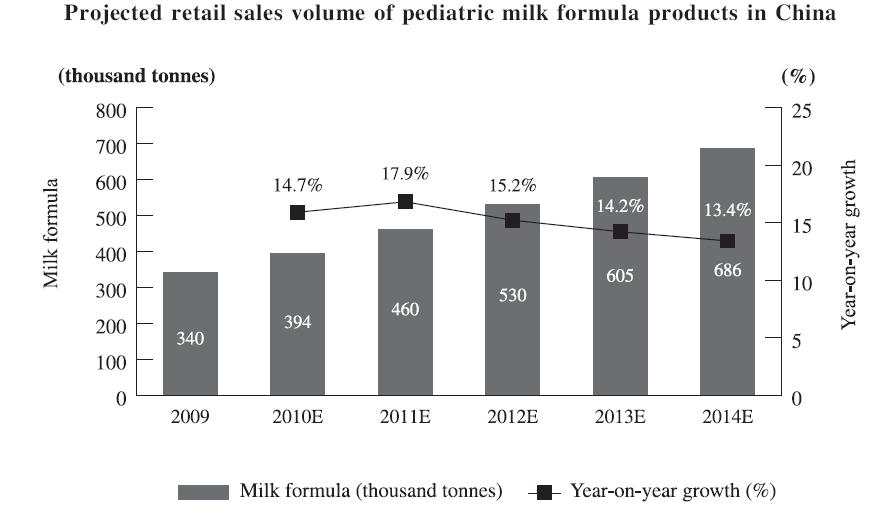
According to Euromonitor International, pediatric milk formula powderproducts accounted for 69.9% of the entire milk powder market in Chinain 2009. Furthermore, the total retail sales volume of pediatric milkformula in China was estimated to be approximately 340,300 tonnes in2009; hence, China accounted for the largest share in the global powderpediatric milk formula market, by total retail sales volume, in 2009,according to Euromonitor International.
Euromonitor also expects China’s pediatric milk formula market tocontinue to grow due to the increasing demand for pediatric milk formula,higher average retail prices for pediatric milk formula products as well asmacro‐economic factors such as increasing urbanization, rising disposableincome levels and the growing number of working mothers.
The retail sales volume of pediatric milk formula is expected to grow by aCAGR of 14.9% from 2010 to 2014, with the retail sales volume sizereaching 686,000 tonnes in 2014. The following chart sets forth theprojected retail sales volume of pediatric milk formula products in Chinafor the periods indicated:
A large number of pediatric milk formula production enterprises, bothforeign and domestic, have entered into China’s market in recent yearsto compete for a share in the nation’s pediatric milk formula market.
Companies like Mead Johnson (MJN), Danone Dumex, Nestlé, (NSRGY.PK), Abbott (ABT), Wyeth, Synutra, Feihe (former American Dairy), Mengniu,Sanyuan, etc. battle with each other in Tier I (Beijng, Guangzhou,Shanghai) and Tier II cities (40 cities, primarily provincial capitals).
But the real deal is done in Tier III (the next 60 cities) and Tier IV (thenext 500 cities). China's cities are classified into tiers based onpopulation number and GDP/capita.
China's smaller cities are unfamiliar territory for many international dairycompanies, which often face competition from Chinese counterparts thatalready know these markets well. Small cities have been serving asincubators for Chinese companies before they expand into larger markets.Such companies are skilled at identifying spaces in the market,experimenting, and learning and adapting as they go. Strong Chinesebrands are emerging in packaged foods, quick-service restaurants, infantproducts, personal care products, footwear, and fashion retail.
Two US-listed China dairy companies are expanding and getting more andmore recognized as quality producer. Which two I am going to tell youknow.
The first one is Rodobo International (RDBO.OB). Rodobo is aproducer and distributor of powdered milk formula products in China.Their target consumers include infants, children, the middle-aged and theelderly. The products for infants and children are currently sold under thebrand names of "Rodobo" and "Peer", and its products for middle-agedand elderly consumers are currently sold under the brand name of"Healif".
Last week's First Quarter 2011 Highlights:
- Revenue was $25.6 million, up 153.9% from $10.1 million in 1Q10,close to the upper range of the Company's 1Q11 guidance $24 - $26million
- Gross profit was $9.8 million, up 84.8% from $5.3 million in 1Q10
- Net income was $4.1 million, up 80.2% from $2.3 million in 1Q10,outperforming 1Q11 guidance range of $3.2 - $3.5 million
- Earnings per diluted share was $0.15, up from $0.14 in 1Q10
I had an email conversation with Stephen Tong, Vice President ofFinance at Rodobo to learn more about the company and their strategy.In the short term they don't have expansion plans to enter Tier 1 or Tier2 cities. Their market niche focus is on 3-tier and 4-tier cities, where theconsumer is price sensitive and there is less exposure to internationalbrands. In other words: less competition for local premium brands likeRodobo.
Marketing in Tier 1 and 2 cities requires the support of national wideadvertisement campaigns on China’s central TV stations which isextremely expensive and it will kill the company's bottom line. Tong thinkstheir current market orientation is fit for the company. However, Rodobowill consider to enter into Tier 1 or 2 cities when the company becomesstrong enough to compete with famous multi-national brands.
The company has plans to introduce new product formulas from time totime. They introduced their “Peer” brand series products (infant formula)in 2009, and purchased the exclusive formula use right for 10 years fromthe Chinese Nutrition Society and create the brand of “Healif” for themiddle-aged product in 2008. Rodobo will continue to introduce newformulas to diversify their product lines by their own R&D team orco-development with institutions
Below you find some questions with answers of my conversation.
How much importance you give to 'high margin' products?
We’ve been pursuing and will continue to pursue “high margin” products.Our overall gross margin was indeed temporarily diluted after theacquisition of Beixue Group which mainly produces low margin whole milkpowder products. As the result, the percentage of low margin productsincreased significantly. However, we believe our current product mix isfavorable. First, our whole milk powder products will enable us toeffectively use our existing surplus capacity in short-term, and we havegreat flexibility in absorbing marketing risks of formulated milk powderproducts in the long run. However, some of our competitors have a highpercentage of infant formula powder which may be influenced by anynegative allegation which was mainly about the infant. Second, thoughthe gross margin of whole milk powder is low, there are very fewdistribution expenses and less administration expense for whole milkpowder as we directly wholesale it to end user’s processing plant. Infantand elderly formula need more marketing and distribution spending.Finally, the acquisition of Beixue is very important to our growthstrategy, the deal is not only less expensive and time saving comparedto building up such a facility ourselves, but also bring us ample andsteady raw milk supply in Hulunbeier grassland which is the best milkorigin in China. It usually requires over 5 years to build up the long termrelationship with farmers if we built new facilities by ourselves. We areremodeling the acquired facilities and upgrading some equipment. We willswitch to producing high margin products step by step which will take a longer time as we need time to expand our marketing channels. It alsodepends on the market demand.


Comments